
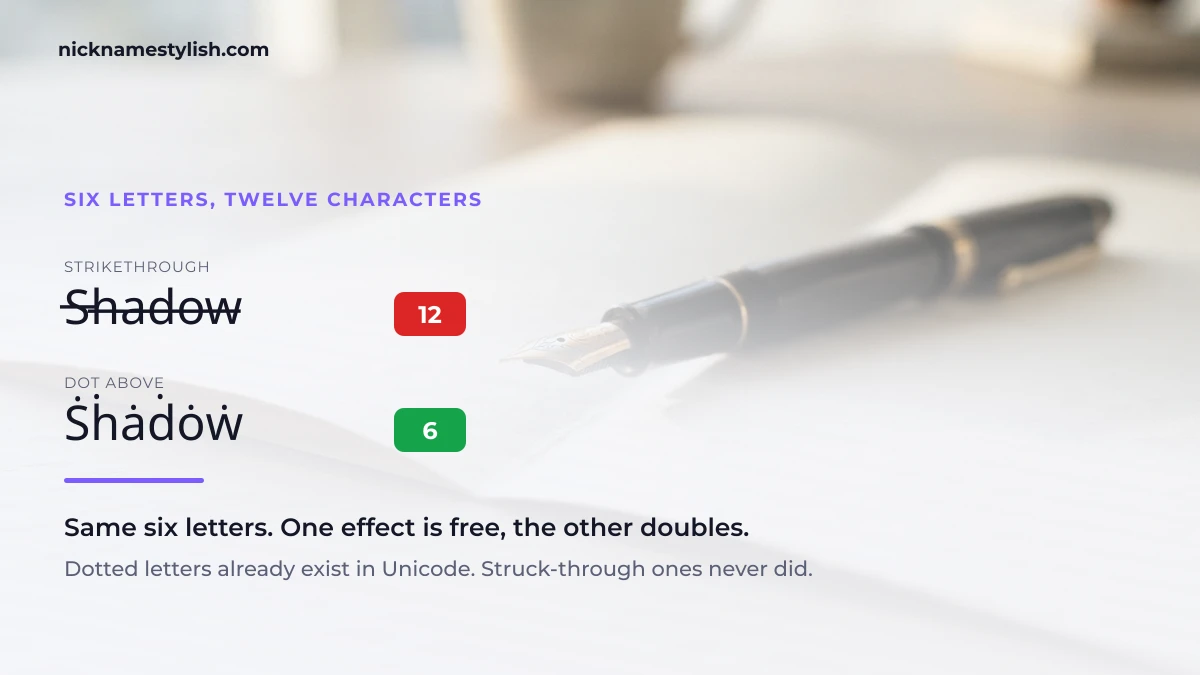
You take a six-letter name, add a strikethrough, and the field tells you it is too long. Nothing was added that you can see — but a strikethrough is a character, one per letter, and six letters just became twelve.
What almost nobody mentions is that this is not true of every effect. We measured twenty of them, and two are free.
Your Stylish Nicknames
Type a name above and press Generate to see your styled nicknames.
Symbols that match this name
Picked for — · tap to copy
Nicknames from the community
Shared by other visitors for —
No nicknames shared yet. Be the first to add one.
Just added
Share your own version
Add a nickname you made so other people can copy it.
How a combining effect actually works
These effects are not a font setting. Each one is a real character that sits after a letter and is drawn on top of it. To strike out six letters you send twelve characters: S, strike, h, strike, a, strike, and so on.
Then something interesting happens. Before storing your text, many systems normalise it — and part of normalising is merging a letter and its mark into a single character when such a character exists. a plus an acute becomes á, one character instead of two.
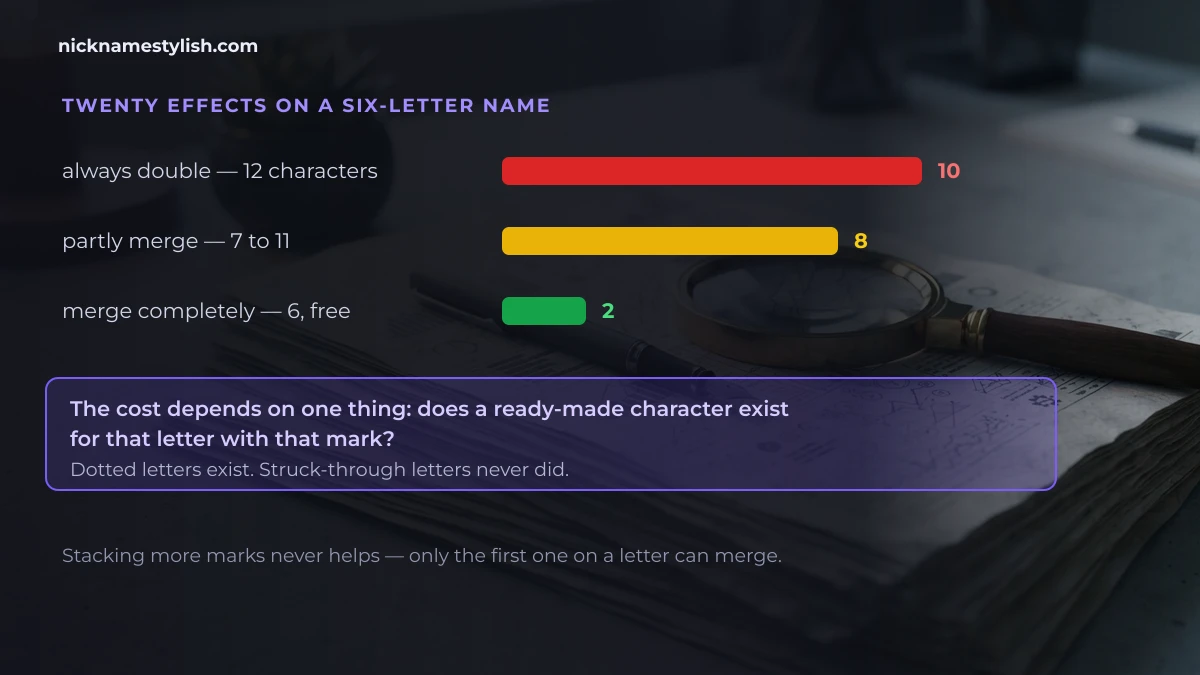
So the cost of an effect depends on one thing: does a ready-made character exist for that letter with that mark?
Twenty effects, measured on the same name
| Effect | Applied to “Shadow” | Characters | After normalising |
|---|---|---|---|
dot above U+0307 |
Ṡḣȧḋȯẇ | 12 | 6 |
dot below U+0323 |
Ṣḥạḍọẉ | 12 | 6 |
caron U+030C |
Šȟǎďǒw̌ | 12 | 7 |
acute U+0301 |
Śh́ád́óẃ | 12 | 8 |
grave U+0300 |
S̀h̀àd̀òẁ | 12 | 9 |
tilde overlay U+0303 |
S̃h̃ãd̃õw̃ | 12 | 10 |
breve U+0306 |
S̆h̆ăd̆ŏw̆ | 12 | 10 |
ring above U+030A |
S̊h̊åd̊o̊ẘ | 12 | 10 |
macron U+0304 |
S̄h̄ād̄ōw̄ | 12 | 10 |
macron below U+0331 |
S̱ẖa̱ḏo̱w̱ | 12 | 10 |
strikethrough U+0336 |
S̶h̶a̶d̶o̶w̶ | 12 | 12 |
short strike U+0335 |
S̵h̵a̵d̵o̵w̵ | 12 | 12 |
slash U+0338 |
S̸h̸a̸d̸o̸w̸ | 12 | 12 |
underline U+0332 |
S̲h̲a̲d̲o̲w̲ | 12 | 12 |
double underline U+0333 |
S̳h̳a̳d̳o̳w̳ | 12 | 12 |
overline U+0305 |
S̅h̅a̅d̅o̅w̅ | 12 | 12 |
enclosing circle U+20DD |
S⃝h⃝a⃝d⃝o⃝w⃝ | 12 | 12 |
enclosing square U+20DE |
S⃞h⃞a⃞d⃞o⃞w⃞ | 12 | 12 |
enclosing diamond U+20DF |
S⃟h⃟a⃟d⃟o⃟w⃟ | 12 | 12 |
crossed out U+20E0 |
S⃠h⃠a⃠d⃠o⃠w⃠ | 12 | 12 |
The two that cost nothing
Dot above and dot below come back to six characters — exactly the length of the plain name. Every letter of Shadow has a ready-made dotted form, so the pair merges each time and nothing is left over.
They are the only two effects in the list that are genuinely free. If you are fighting a character limit and still want the letters marked, start here.
The ones that are partly free
Eight effects land in between. A tilde over a and o has a ready-made form, so those two merge; over S, h, d and w it does not, so those stay as pairs. The name ends up at ten instead of twelve.
The cost therefore depends on which letters your name contains — the same effect can be cheap on one name and expensive on another.
The ten that always double
Strikethrough, underline, overline, the slashes and all the enclosing marks stay at twelve. There is no ready-made struck-through S in Unicode, so nothing can merge — the mark stays a separate character forever.
These are the popular ones, and they are the expensive ones. A six-letter name in strikethrough uses the whole of a twelve-character field.
Marks work on symbols too
A combining mark attaches to whatever came before it, and that does not have to be a letter. A star can be struck through the same way a letter can — and it costs the same one extra character.
Plain — one character each
Struck through — two characters each
None of these merge, because no ready-made struck-through star exists. The cost is fixed.
Kaomoji, plain and marked
A kaomoji is already several characters, so marking every one of them is expensive. The number on each chip is the real count.
Plain
Every character marked — the heavy look
Emoji and marks
You can put a mark after an emoji and it counts as a character, but the result is unreliable: most systems draw the mark beside the emoji rather than across it, because emoji are drawn from a separate font that has no idea what to do with a combining stroke.
Worth knowing before you spend a slot on it.
Plain emoji
With a stroke added — costs one more, looks unpredictable
Stacking more than one mark
You can put several marks on one letter, and only the first can ever merge. a with twelve acutes is thirteen characters and normalises to twelve — the first merges into á, the other eleven each keep their own slot.
Worth knowing if you were planning the very heavily decorated look: each extra layer is a full character per letter, with no discount after the first.
Mark order does not matter here
If you use two different marks, the order you type them in gets rearranged during normalising, so a + dot below + acute and a + acute + dot below end up as the same text. That is convenient — it means two names that look the same really are the same, and search will match them.
This is not true in every script. In Thai, for instance, the vowel and the tone mark cannot be reordered, and the two orders stay different strings forever.
What to do about it
- Count after the effect, not before. A six-letter name is not a six-character name once it is decorated.
- If the field is tight, use dot above or dot below. They are the only two that cost nothing.
- Strikethrough is the most expensive popular effect. Budget double.
- Do not stack layers to save room. Only the first mark on a letter can ever merge.
- Check by pasting, not by counting letters. The field will tell you the real number.
Community kaomoji bank
100 faces from the shared library — tap any one to copy. Invisible formatting characters and right-to-left characters have been filtered out, since both break names in ways you cannot see.
Community nickname bank
117 nicknames submitted and copied most often by readers across the network.
Frequently asked questions
Why does my strikethrough name get rejected as too long?
Because each strike is a separate character. Six letters with a strike is twelve characters, and no normalising can reduce it.
Why do some effects shrink and others do not?
Because merging only happens when a ready-made character exists for that exact letter and mark. Dotted letters exist; struck-through letters do not.
Is the effect lost when the text is merged?
No. The result is the same shape, drawn as one character instead of two. It looks identical and costs less.
Can I strike out only part of a name?
Yes — the mark applies to the letter before it, so you can decorate any subset. The cost is one character per decorated letter.
Do these effects survive being copied?
Yes, they are ordinary text. What varies is whether the receiving system normalises, which only changes the count, not the look.
Which effect looks strongest for the fewest characters?
Dot above, since it costs nothing at all after normalising. Among the fixed-cost ones, the enclosing marks read as the most dramatic.

NicknameStylish Editorial Team curates and tests stylish Unicode text in the actual apps — the PUBG Mobile and Free Fire name fields, Instagram and Facebook — and publishes only what we have verified renders.